
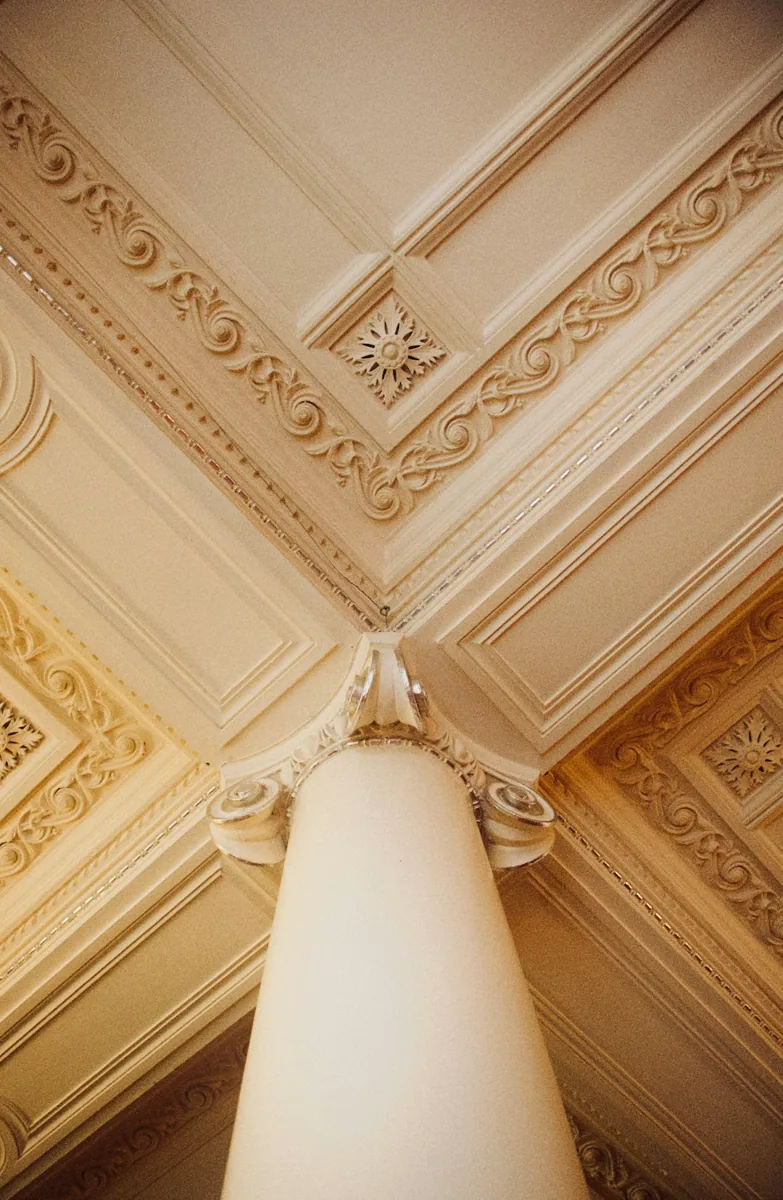
Decorative plaster mouldings
Ceiling roses, cornices and decorative mouldings: assess the profile, fixing, repairs and final finish before work begins.
On this page
Fitting ceiling roses, cornices and mouldings
Proportion matters as much as the profile
A deep cornice in a low room has a different effect from a narrow moulding along a high ceiling. Send a photograph of the whole room, its ceiling height and wall lengths, and the positions of doors and windows. For a ceiling rose, include the size and fixing point of the light fitting. A sample profile helps you judge the proportions in the room.
Check the substrate and connections
Mouldings and ornaments need a suitable, stable substrate. Existing loose sections, cracks and old paint layers should be assessed first. Agree how internal and external corners, joints and edges will be finished. Identify any pipes, ventilation or wiring behind or alongside the decoration.
Match repairs to the existing profile
For a damaged old ornament, record the original relief and proportions. Send overview photographs and close-ups with measurements. Discuss whether the proposal is a local repair, replacement of one section or a new matching profile. Include painting as a separate item so the transition between old and new is clear.
This is what you discuss in advance
- Provide the ceiling height, moulding lengths and light fitting dimensions.
- Compare a sample profile in the room.
- Specify fitting, joint finishing and painting separately.
Details of the finish
More questions about decorative mouldings
Can an existing ornamental frame be restored?
This depends on the material, damage and fixing. Detailed photographs and measurements help with the initial assessment; an on-site inspection may also be needed.
When are ornaments painted?
Allow the fixing and filling materials to dry as required before painting. Agree the preparation and paint system for the selected material and follow the product instructions.
Choosing mouldings to suit the room
Scale, profile and position all matter when choosing decorative mouldings. A deep cornice may suit a high ceiling but feel too heavy in a lower room. Consider door heights, window surrounds, lighting and the building’s existing style.
Agree whether existing sections will be retained, repaired or replaced. Check the substrate and fixings, then discuss joints, corners and painting. The condition of the surrounding ceiling is part of the assessment.
What to agree before work starts
| Component | What should you discuss? |
|---|---|
| Existing moulding | Photograph the profile, damage and joints. |
| New ornament | Match its diameter and position to the light fitting. |
| Corners and joints | Agree how corners and joints will be finished. |
| Painting | Agree the preparation and who will apply the final coats. |
What to include in your enquiry
Replacing a ceiling light can expose damage to an existing ceiling rose. Before dismantling it, assess whether repair is possible and how the new fitting will sit against it. Even a small change in position can affect the ornament and the surrounding finish.
Use this example to prepare your enquiry. The actual condition of the room determines the appropriate method.
Decorative finishes in context
Interior photographs showing how surface finish and lighting work together.
Questions about this finish
Can old ornaments stay in place while plastering?
This depends on their condition and the work around them. Agree how they will be protected and how the new plaster will meet the existing profile.
Can I replace one piece of an ornamental frame?
Sometimes, provided the profile, dimensions and material can be matched. Ask how visible the joint may be and what painting will be needed afterwards.
Continue your preparation
Discuss your plastering project.
Send your plans, photographs and approximate dimensions. We will discuss suitable preparation and finishing for your home.
Working on a historic building?
Original plaster and decorative details need an assessment before anything is removed or replaced. Read about the approach to heritage plasterwork.
Heritage plasterwork →